
An Introvert’s Guide to Building a Village
10 ways to organize your neighbors into a village
I’m an introvert. Small talk is hard. Cocktail parties are exhausting. But give me a shared project, a shared activity, a shared goal — and I show up excited. Every single time.
This list is built from that place. These are things I would actually do. Things I am actually doing. And if you’re an extrovert reading this — welcome. This might also just be a guide to help you mobilize the introverts in your life into social action.
We’ve forgotten how to be neighbors.
(I made a podcast and video on this too)
The human industrial complex has done a number on us. We’ve been so fragmented, so overstimulated, so extracted from our own lives that we’ve lost the most basic human skill there is — showing up for the people who live near us.
And right now, at this particular moment in history, the antidote isn’t online. It’s not a petition or a post or a thread. It’s outside. On your block. With the people who live there.
I want to be clear about something before we get into the list. We are building a village, not a brand. Villages don’t get to be curated. Your neighbor’s yard sign doesn’t disqualify them from your porch. That’s not in spite of your values — it’s because of them. The village IS the value. We are not trying to create cliques or clubs or real life echo chambers.
One rule before we start: Your neighbor is a human first, not a voter. Leave the politics and the assumptions out of your interactions. This is a true discipline — listening with an open mind and embracing conflict as a gift, because conflict is a teacher, and learning to accept it is the community glue.
Now. Ten ways to actually do this.
The List
1. The Color Hunt
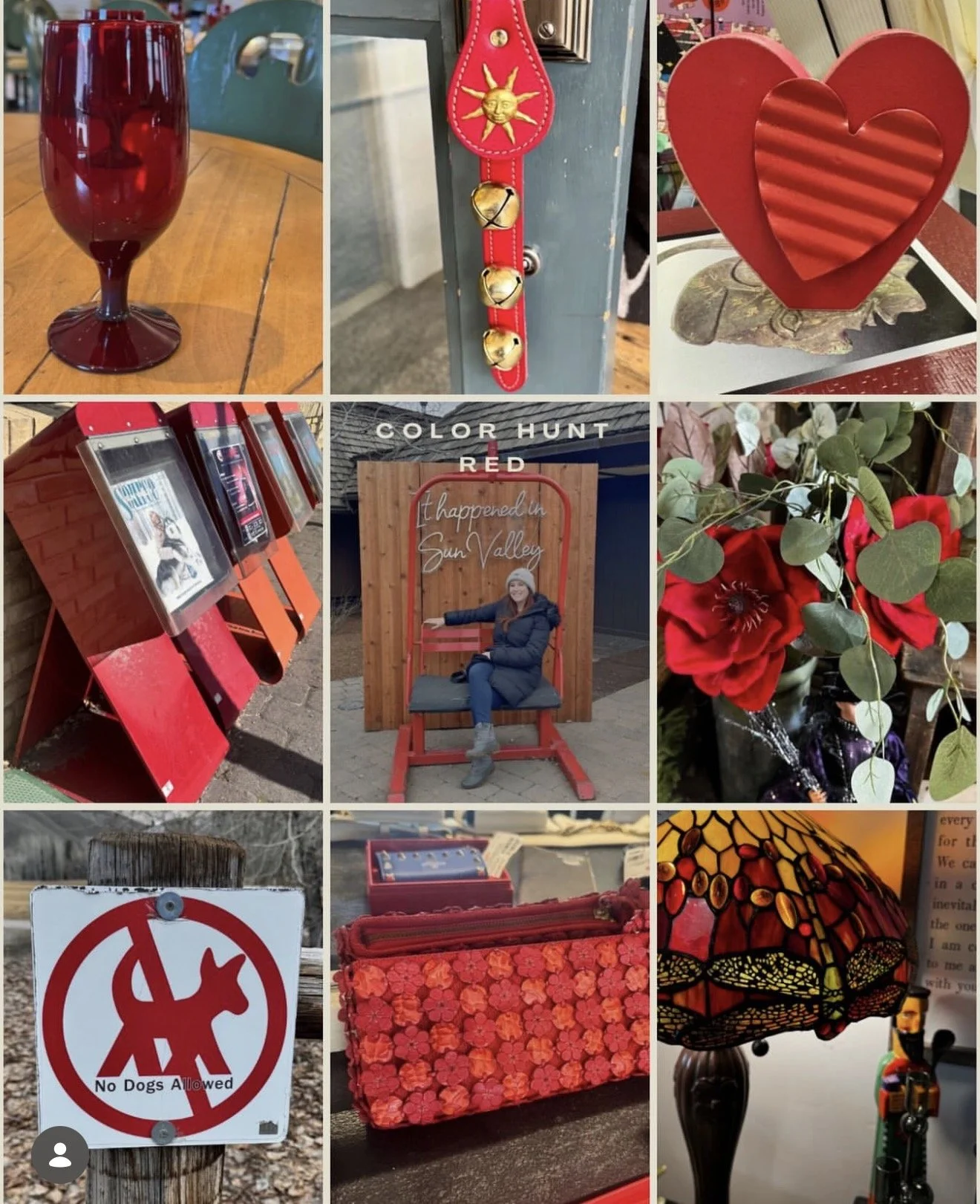
During our annual ski trip to Sun Valley, it was warm and Spring like and the snow was too slushy for great skiing, so my niece suggested we do something simple. Each person picks a color. You spend the day photographing everything you see in that color. Then you make a collage.
That’s it. That’s the whole thing.

Color Hunt Collage from Sun Valley - I am a contrarian so I broke the rules and chose a color story instead of a single color. My color story was English Rose Garden
We did it. It was genuinely fun. We wandered around noticing things we would have walked right past. We made something together. We had something to talk about.
The color hunt works anywhere — your own town, your own neighborhood, your own street. You can do it alone, which is meditative. You can do it with friends & neighbors, which is connective. And it has built-in seasonal versions: all pink for Easter, all green for St. Patrick’s Day, red and green for a Christmas card that’s actually personal. Go find your neighborhood in a color and make a collage. That’s your card this year.
Also, this is a great way to satisfy that hunter gatherer instinct with consuming a thing. No shopping, just creating.
2. Open Social Hours / Porch Time
Open your door at a regular time every week. That’s the whole idea.
Not a dinner party. Not an event. Just — I’m out here on Saturday afternoons from 3 to 6 if anyone wants to come by. Maybe there’s popcorn. Maybe there’s wine. People can come and go. No agenda, no performance, no hospitality pressure. Don’t even worry about the dust.
The regularity is everything. It has to happen every week or it doesn’t happen at all. Consistency is what turns an open door into a gathering place.
3. Dog Park Hours for the Dog-Less
I know this one is a little weird. But dog parks are one of the last genuinely public third places where strangers actually talk to each other, and there is often one near many neighborhoods in the city or suburbs.
Nobody is staring at their phone. Everyone has an immediate conversation starter. The social atmosphere is warm and low stakes.
You don’t need a dog — you just need a tolerance for a little slobber.
Show up, sit on a bench, let the dogs do the social work. Nobody is going to ask for your credentials. Dog people are friendly people. This is a free community gathering that already exists in most towns and almost nobody without a dog thinks to use it.
When someone asks you which one is your dog, just tell them you’re there because you love dogs. Share a story about a dog you once had, or mention that you’re thinking about getting one — trust me, people will want to know more or help you.
4. Pickup Games
Kids do this spontaneously. They show up at the park, somebody has a ball, something happens. No teams, no registration, no commitment.
Adults can do this too. We just forgot.
Basketball, baseball, bocce, croquet, cornhole, chess in the park. The game is almost beside the point. The point is showing up somewhere at a regular time with no agenda and seeing who else shows up. Low stakes, no skill requirement, anyone can join mid-game.
It’s worth a try. Often kids will ask to join, and then their parents arrive. Or you might need to shoot a quick email to your neighbors letting them know you’ll have croquet set up at 6. Basketball courts are especially easy — people always want to join in.
If you live somewhere with a park, a court, or a field, you already have everything you need.
5. Don’t Hide
Parents have a built-in social infrastructure that childless adults simply don’t. The school pickup line. The soccer sideline. The neighborhood kids pulling everyone outside at the same time every afternoon.
If you don’t have kids, nobody is forcing you out the door at the same time your neighbors are out. So you have to manufacture it. It’s not stalking — it’s strategy.
Show up outside at the same times your neighbors are out walking their dogs, hanging out on their porches, or going to the mailbox. Walk to the end of your driveway. Be visibly present in your own neighborhood at a predictable time. Regularity is what turns strangers into neighbors.
Don’t hide.
6. Walking Parties
Walking side by side does something to conversation that sitting face to face simply doesn’t. There’s less performance, less eye contact pressure, more room for the thought to just come. It’s why some of the best conversations happen on the way somewhere rather than at the destination.
Walking is like wine. The conversation flows.
Invite one person. Walk somewhere. See what happens. This requires almost nothing and delivers more than most planned social events.
7. Meal Prep Together
This one solves a practical problem and creates connection as a byproduct — which is honestly how most human connection has always worked. People didn’t schedule quality time. They just did things together.
Get two or three people together, share ingredients, split the bill, fill everyone’s freezer. You have a task. The connection happens around the task. You save money. You eat better. And you spent a few hours with people you care about without anyone having to perform.
This is how most of human history worked. We’re just rediscovering it.
8. Porch Hopping
Convince your neighbors to open their porches on the same afternoon. Then just drift from one to the next.
That’s a progressive dinner without the cooking pressure. That’s a block party without the permit. It’s Tapas American Style. That’s what a neighborhood used to feel like on a summer evening — people outside, doors open, movement and laughter spilling from one yard to the next.
If you can get even three or four households to do this once, something shifts. People start to feel like they live somewhere, not just sleep somewhere.
9. The Neighborhood Newsletter
This is the antidote to Nextdoor.
I don’t know how it is for you, but I have lived in a few states and my experience with Nextdoor hasn’t been great. Nextdoor optimizes for outrage because outrage drives engagement. It becomes a place where the loudest, most aggrieved voices dominate and everyone else just feels worse about their neighbors. It is not a community tool. It is a complaint forum with a map.
A neighborhood newsletter has a different editorial philosophy by default: we are for each other, it slows down the conversation, and gives us something to look forward to instead of being served distraction every second.
It’s a place to announce birthdays, anniversaries, joys and concerns. A place to share favorite covered dish recipes, backyard chicken stories, or delight in what is showing up in the garden or who is showing up at the bird feeders. It can fascilitate exhange: labor such as yard work, book/harvest/tool libraries
The local pipeline update. Porch party announcements. New neighbors introducing themselves. Bocce at the park at 6:00, all are welcome.
It’s a care document. It says: we see each other here. It can be weekly, monthly, or quarterly.
One important note — start with the porch first. Know your neighbors before you start reporting on them. The newsletter serves the village. The village does not serve the newsletter. If you start with the newsletter before you have real relationships, it becomes another screen, another platform, another thing to manage. Get outside first. Let the newsletter be the fruit, not the seed.
Ours is a monthly that goes out by email and eventually by paper. Both matter for different reasons. The paper version is the one people might actually keep and post to their fridge — reminding them that a village always exists.
10. The Neighborhood Podcast
This one is last because it’s the most ambitious — but also maybe the most beautiful.
What if you recorded conversations with your neighbors? Not for the internet. Not for growth. Not to go viral — going viral is a disease, this is the immunization. Just for the block. Audio shared only through the newsletter, available only to the people who live there.
Nancy at 88 talking about what this road looked like fifty years ago. The kids explaining was 67 means. Someone describing how they ended up here, in this particular place, on this particular street.
In twenty years that’s an archive. That’s irreplaceable. That’s the opposite of content that disappears in 24 hours — it’s a time capsule.
You’re taking the global infrastructure and making it hyper local. A podcast with an audience of forty people who all know each other. That’s not small. That’s exactly right.
Where to Start?
You don’t have to do all of this. Please don’t try to do all of this.
Start one thing. Show up outside at the same time next week. Open your porch on Saturday. Go to the dog park without your dog.
Get to know your neighbors first. Let everything else grow from there.
The village doesn’t have to be built all at once. It just has to be started.