
The Human Industrial Complex: An Origin Story
In the beginning there was a garden. And in the midst of this garden, a tree — or two trees — or perhaps one tree that could be approached in two different ways. Think of an American politician who is approached one way or another depending on the political orientation of the approacher, creating two politicians in essence, a bad one and a good one. However, in actual existence there is only one politician.
Maybe that’s how it is with the tree of life and the tree of the knowledge of good and evil. Genesis places them both in the same location, the sacred center. It is debated whether they are the same tree entirely. What do you think? When it comes to being human, perspective and orientation is the reality that is acted upon not the thing itself. God said eat freely — from every tree, including the tree of life. Abundance was the baseline. Trust was the only requirement.
But not from the tree of the knowledge of good and evil. Not because knowledge is dangerous. But because taking it meant taking over. It meant deciding you were now responsible for your own provision, your own judgment, your own survival. It meant picking up the burden of being your own god. Don’t do that. Trust the provider. You are the receiver, not the source.
And then there is the Serpent whispering.
“Did God really say you shall not eat from any tree in the garden?”
Eve corrects him immediately. No — we may eat freely from every tree. Just not that one in the middle.
But notice what just happened. The Serpent didn’t need the lie to land. By asking the distorted question he had already accomplished something more subtle — he shifted her attention from the abundance to the restriction. The conversation is now about the one prohibited tree rather than the lavish permission of every other. The garden full of fruit recedes. The one forbidden thing fills the foreground.
You don’t have to manufacture scarcity. You just have to make people look at what they don’t have instead of what they do.
“You will be like gods.”
That is the oldest sales pitch in human history. Not an offer of wisdom but an offer of autonomy. Control. The grasping hand. Take it. It’s yours. You deserve it. And by the way — don’t you feel a little cheated that you don’t already have it?
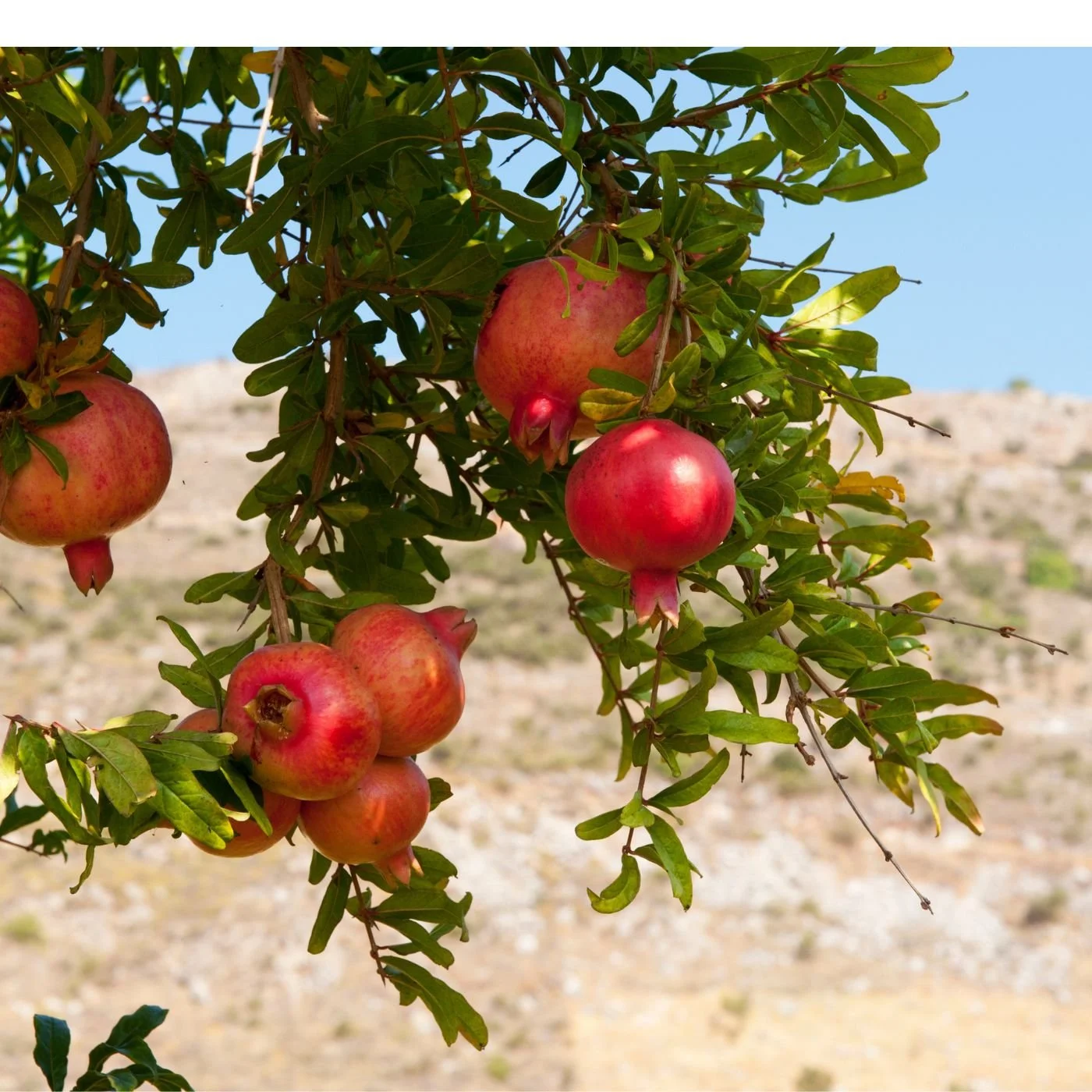
This is the orientation that would eventually build empires. It didn’t start with armies or legal codes or conquest. It started with a whisper in a garden. A reframing of the sacred as something to be seized rather than received. The pomegranate, with seeds like rubies. The same fruit that bound Persephone to Hades.
And what about the fruit? In the Song of Solomon the pomegranate carries two meanings simultaneously — life and entrapment, wisdom and consumption — depending entirely on how you approach it. The pomegranate was native to the region, deeply embedded in ancient Near Eastern symbolism, and present throughout Hebrew scripture in sacred contexts.
But there is also the fig — and we know there were figs because both Adam and Eve covered themselves with the leaves. The fig always shows up in the story — including the moment Jesus curses a fig tree full of leaves but no fruit, most likely a symbol of institutional religion that looks alive but produces nothing. Not likely the apple, which would have been hard, sour, and the least inviting in its wild state. We don’t really know, but for the purpose of this story we are going with the pomegranate — based on the Song of Solomon and the knowledge that the fig is a symbol of peace, which is surely not what follows.
The Serpent is the Human Industrial Complex in its larval form. What follows is its coming of age story.
The Human Industrial Complex didn’t begin in America, or Britain, or even Rome. It is very old. Older than Caesar, older than the Pharaohs, older than the ziggurats of Babylon.
There is a settlement in modern-day Turkey called Çatalhöyük, occupied roughly ten thousand years ago. Archaeologists have found something unusual there — or rather, a striking absence of the usual. No palace. No dominant temple. No graves stuffed with gold, the bones of sacrificed wives and pets. No male loneliness epidemic for the powerful dead. The evidence suggests people living relationally rather than hierarchically. Not extracting from one another. Not organized around domination.
This is the sacred open hand. What belongs to one belongs to all. Life received rather than hoarded. The tree approached with humble receptivity rather than grasping.
Çatalhöyük is not alone. Across multiple archaeological sites in Old Europe, the Aegean, and the ancient Near East, evidence points toward societies that were matrilineal, goddess-centered, and organized around partnership rather than domination. Scholars like Marija Gimbutas and Riane Eisler have documented this at length — and while their work is debated, the core observation holds: patriarchal hierarchy is not the default human setting. It has a history. It had a beginning. And all things with beginnings end.
Which raises an uncomfortable question. If domination is not human nature but human drift — if there was a before — then what caused the transition?
The most honest answer is that we don’t know exactly. But the timing is suggestive. Agriculture creates surplus. Surplus creates property. Property requires inheritance. Inheritance requires certainty of paternity if the greed belongs to the men. And certainty of paternity requires the control of women’s bodies. Had the greed been with women, there would have been no need. The mother is always known.
The machine doesn’t begin with malice. It begins with wheat. Or, pomegranates and their haughty seeds.
And somewhere in that drift, the grasping hand reappears. Mine. My surplus. My land. My lineage. Her body, my property, my legacy on Earth.
The Serpent begins to grow legs.
By the time Assyria rises we can see the machinery clearly — military conquest, systematic tribute, terror as policy. The me-me-me orientation has gone institutional. It wears the armor of civilization now. It speaks the language of order and divine sanction. The Serpent is no longer whispering. It roars without even trying to cover up its intent.
Babylon codifies it. Hammurabi’s famous law code — written around 1750 BC, one of the earliest legal documents in human history — is simultaneously a justice document and a domination document. Because now both need to be enforced, as does everything that veers from nature like dams and levees. Hierarchy is sanctioned from above, the king as divine instrument of order.
The Beast is born.
Women, in particular, were considered property. The code makes this plain:
On adultery: A woman caught in adultery could be thrown into the river with her lover — unless her husband chose to spare her. The husband had the option. She did not. A man’s adultery was only an offense if the other woman was already married — making it a property violation against another man, not a moral wrong in itself.
On accusation alone: If a man accused his wife of adultery but couldn’t prove it, she could clear herself by jumping into the river. Trial by ordeal. If she survived, she was innocent. The river decided.
On widows: A widow could remarry, but only under very constrained conditions. Her dead husband’s estate essentially controlled her options.
On divorce: A husband could divorce a wife relatively easily. A wife who tried to leave, or who was deemed to have neglected her house, could be drowned or sold into slavery.
On rape: The violation of an unbetrothed virgin was treated primarily as an offense against her father — property damage, essentially — rather than a crime against her person.
The through line is consistent: women as property. Wives belonging to husbands, daughters belonging to fathers. The law protects male interests in female bodies rather than female persons in their own right.
This is the clenched fist made law. The grasping orientation seized, locked down, given divine sanction and written in stone. So embedded in human imagination that even liberation carries its fingerprints.
Babylon did not invent this. But it codified it and handed it down.
And a king in every home, temple, and business — each one carrying the same code as the king on the throne. The system doesn’t just hold its shape. It replicates into fractals. The macrocosm recapitulates the microcosm. As above, so below.
Egypt, Greece, and Rome each inherit and refine the same basic operating system — the extraction, the hierarchy, the divine sanction of whoever holds power. The machine grows more sophisticated with each iteration. It learns to justify itself in the language of order, civilization, and the gods. The creature that whispered to one person in a garden now has wings. It can project power across continents. It doesn’t just conquer — it assimilates. It offers roads and law and philosophy. The most sophisticated form of the grasping hand is the one that looks like an open hand.
The Serpent is fully grown.
Into this world Jesus is born. Under Roman occupation. In a backwater province. To an unwed mother — thank God this didn’t happen in Babylonia in 1700 BC. There are times in our history when Christ would not even have been allowed to be born. The control ebbs and wanes but never holds steady because it’s not natural.
And at the very beginning of his public ministry, before he heals anyone or teaches anyone, he is taken into the wilderness. And there the Serpent comes to him again — ancient now, wearing the face of reason.
All the kingdoms of the world. All their glory. All their power. You will be like gods.
Same pitch. Ten thousand years later. The Serpent apparently has only one move.
This is the Human Industrial Complex at full flower, offering itself to the one person who might have used it well. The grasping hand extended. Take it. It’s yours.
He says no.
He recognizes it. He had seen what the grasping orientation had built across ten thousand years of human history. He had seen the law codes and the empires and the women thrown into rivers. He knew what the Serpent was and what it always produced.He knew where the story goes. It always ends the same way.
He chooses the open hand instead. Receiving rather than grasping. Community rather than control. The we rather than the me.
This is not a small moment. This is Jesus standing at the headwaters of his entire ministry and declaring what kind of kingdom he is not building.
The movement he leaves behind knows this. For two centuries they live accordingly.
Perhaps he was trying to take us back. Back to the garden. Back to the Eden of Çatalhöyük. Back to the sacred center where the tree stands — not to be seized but to be received.
Back to the open hand.
The Serpent, of course, was not finished. What happened next — how the Beast found its way inside the church — is a story for another post.