
Leading Worship at my Quaker Meeting | A message about the Gifts that come from Slowing Down and Staying in the Now
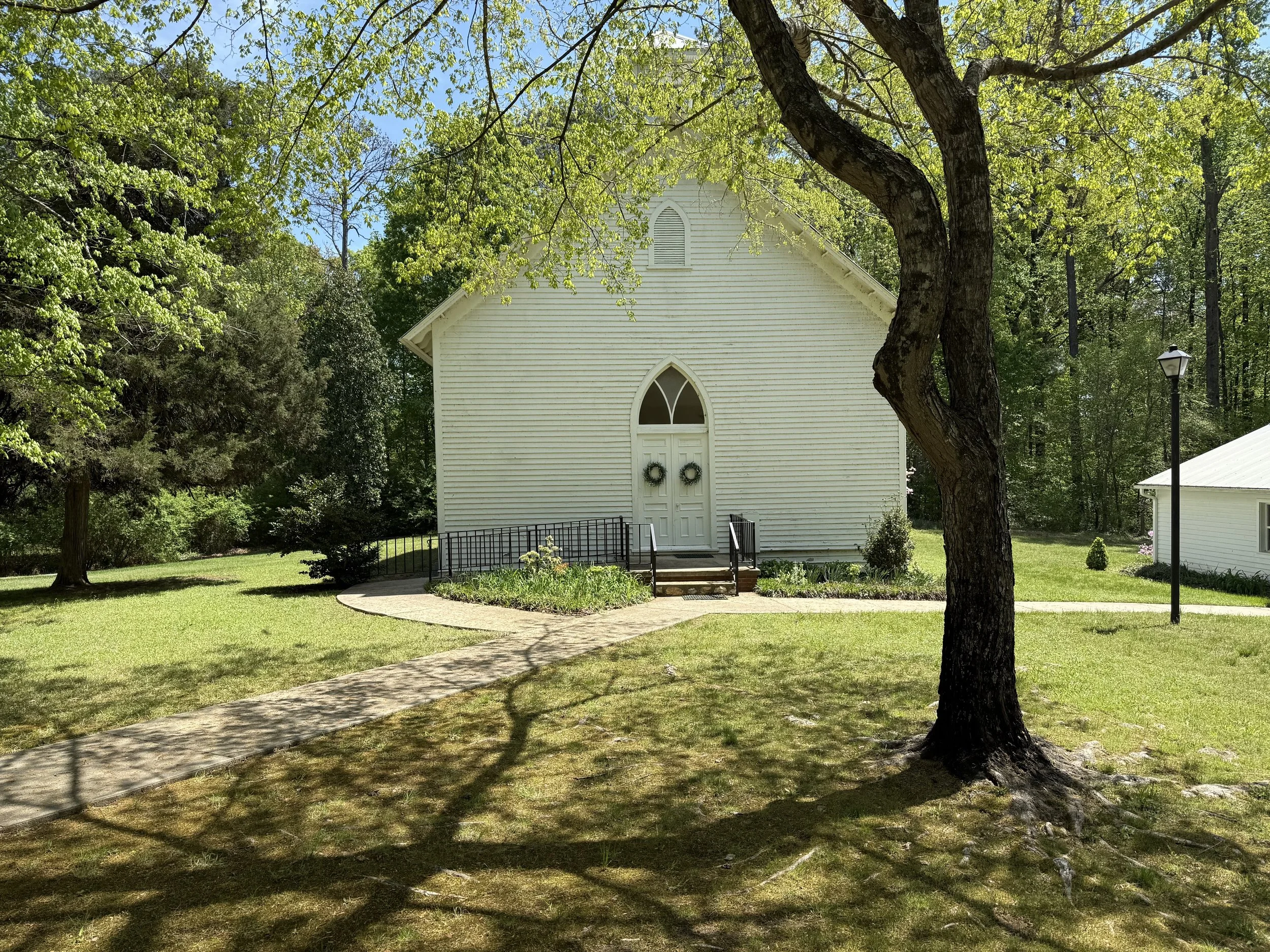
I attend a Quaker meeting. It’s a country meeting in the middle of the Quaker belt of North Carolina. There are several other meetings within a few miles. Our meeting house is a small eggshell white clapboard building not much different than a 19th century one room school house. It even has a bell cupola on top used for weddings now but once used for summoning children. It is plain and elegant but the gothic arched windows with their beveled glass gives it a swan’s grace. It’s surrounded by lush forest with a gentle spring flowing behind it where the daffodils and tulips gather in April.
There are lots of different types of Quaker meetings, but one typically begins to sort them by whether they are programmed with a paid pastor or unprogrammed, which usually means no pastor and no liturgy at all. Attendees just sit in waiting silence for an hour waiting for direct revelation through God, or spirit, or the universe, or the light fantastic — whatever one chooses to call it. And sometimes they will speak out of the silence and reveal the message.
My meeting is semi-programmed, meaning we sit in silence for most of it but we the laity/clergy volunteer to lead worship, typically with a message. Authority is distributed amongst us and not bestowed upon one paid person. Yesterday was my turn to volunteer.
First I recited The Peace of Wild Things by Wendell Berry and after a moment of silence, I gave the following message:

Friends,
I was talking with my father the other day. He’s been retired for at least 20 years and he loves to read about history and philosophy all day long he does this — and then goes out and walks miles. He and my stepmom, to a restaurant with a view of the ocean or a golf course. Somewhere were they are known and they know everybody’s names because they always stay awhile.
When he reads, he takes lots of notes and even keeps a spreadsheet of everything he’s read including the masterclasses he’s taken. I suspect he does this so he can have better conversations with himself.
When we get together over the phone or in person, he wants to talk about all that he has been studying. I feel sometimes that I am the most qualified out of all of his kids to do this since I am interested in many of the things he studies —
but honestly, I do not spend the same amount of time with the material, I don’t write notes or queries, and sometimes I rush through it like I am fishing for a concept and when I get it, I move on to something new.
I sometimes worry that he has studied himself into a lonely corner. But still all those dead authors are probably the best company in the world. I bet they listen to him too. Why not? All they have is time.
Last week, we got onto the subject of Blinkist — an app that summarizes a book in 15 minutes or less, giving you the key points, the plot, and the script to convince others that you read the book. It’s a way to jam reading between the tight spaces of your to do list. Or, maybe even replace scrolling. That’s good.
The New York Times described Blinkist: a tool for acquiring as much information as possible.
I could hear the silence of my dad shaking his head through the phone.
I say that sounds like jamming an overstuffed duffel bag into the overhead compartment of my brain. I am going to make all that information fit even if it breaks something else.
He says.
It’s actually important to spend time with a book. There are concepts and questions that only bubble up to the surface after a few hours of sitting with a singular theme. Ideas you never thought you were capable of.
He continued, and you miss the moment where something shifts in you and you don’t even know how or why, but suddenly you are different.
Yes, I say, there is a muse that arrives when you take your time with a book, but she’s not going to come until you show some seriousness. She is the sister to the writing muse.
You see-
It’s not really about the information — unless you are just looking to impress someone at a cocktail party, and these days few are impressed anyway. It’s about formation.
We don’t just do this to our books, we do it to our whole lives.
We rush through dinner to get to — what exactly?
We rush from task to task, so we can end up where?
I want to ask that question seriously. What is waiting for you on the other side of the rushed meal? Is it something that forms you? Something that restores you? Or is it a screen? Is it more noise?
Because here’s what I’ve come to think. We are not always saving time when we rush. Sometimes we are just making room for something lesser.
There’s a story in Luke that I would like to read to you. It’s Luke 10.
At the Home of Martha and Mary
38 As Jesus and his disciples were on their way, he came to a village where a woman named Martha opened her home to him. 39 She had a sister called Mary, who sat at the Lord’s feet listening to what he said. 40 But Martha was distracted by all the preparations that had to be made. She came to him and asked, “Lord, don’t you care that my sister has left me to do the work by myself? Tell her to help me!”
41 “Martha, Martha,” the Lord answered, “you are worried and upset about many things, 42 but few things are needed—or indeed only one.[f] Mary has chosen what is better, and it will not be taken away from her.”
Now I don’t think Jesus is dismissing the cooking. The meal matters. Although, she probably could have done something more basic — he would be happy with just bread and wine
I think what he’s pointing at is that Martha is not there. She is in the kitchen but she is somewhere else inside herself — anxious, resentful, running through the list. She is rushing through her own life. And Mary is simply present. That’s the whole difference. Not what they’re doing. Where they actually are while they’re doing it.
And seriously, why host a messiah when you aren’t going to be present to the messiah?
We know what it feels like to eat a meal and taste it. We know what it feels like to do the dishes and just — do the dishes. To be in the warm water and the quiet and let the mind go where it goes. These are not wasted moments. These are the moments we are actually alive in.
The 23rd psalm says he leads me beside still waters. He restores my soul.
And I’ve read that a hundred times. But lately I hear it differently. You cannot be restored at speed. Speed is meant for chasing and being chased.
Still waters are where you are safe. Restoration is slow by nature. It cannot be summarized or rushed or scheduled into fifteen minutes. It happens to you, gradually, when you are present long enough to receive it.
Emily Dickinson wrote that forever is composed of nows. Not a different time. This time. Which means every moment we race through — every dinner we swallow without tasting, every conversation we half-attend, every ordinary task we treat as an obstacle — that’s not nothing. That is eternity we decided not to live.
My father is 85. And when I talk with him there is a quality of attention he brings that I am still learning. He is not rushing to the next thing. He is just — here. With me. In this conversation. It is a gift that age sometimes gives, if we let it.
The urgency quiets. And life becomes visible in a way it couldn’t when we were racing through it. I now spend flights looking out the window — what a marvel to watch the slow changes of time at the speed of jet fuel — and what craziness it is that the person next to me is playing “Bejeweled” while we fly over the Grand Canyon. I mean I do read and watch movies on the plane, but never over the Grand Canyon.
But we don’t have to wait for age to teach us.
We could just slow our roll.
Savor each bite and enjoy your life as if Now were forever.
let us enter into open worship
let’s us greet each other in the manner of friends