
Luke 10: The Feminist Subversion in Plain Sight
I have a theory. You can learn a lot about a woman by how she reads the story of Mary and Martha.
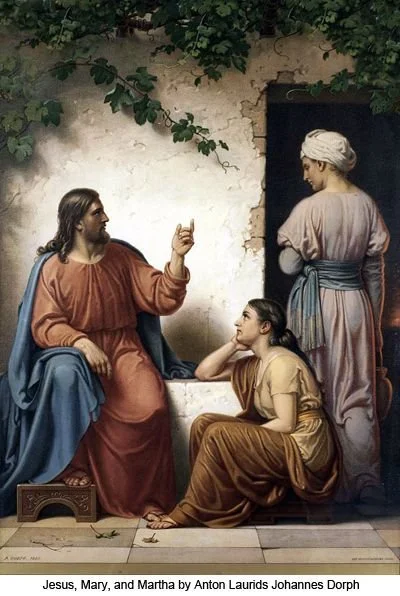
Some of my friends are genuinely irritated with Jesus in this passage. Their read: Martha is the good sister. She’s doing the actual work. Mary is just sitting there — at the feet of the Messiah, sure, but still. Someone has to make the food. Someone has to be responsible. And Jesus not only fails to help, he takes Mary’s side?
I understand the frustration. I really do. But I think we’re missing something.
The sitting-at-feet detail is doing more work than it first appears. That’s not casual lounging. That’s the posture of a disciple receiving teaching from a rabbi. Women weren’t supposed to be in that position. So when Jesus says Mary has chosen the better thing, he’s not validating her laziness — he’s validating her as a student. As a disciple. That’s the feminist subversion hiding in plain sight.
And nobody ever says a word about the apostles hanging around while women serve them. That’s just background. That’s just how things are. But Mary sits at a rabbi’s feet to learn, and suddenly someone has a problem with the division of labor. Her sister no less.
Which makes Martha’s complaint even more pointed. She’s not just venting — she’s asking Jesus to enforce the gender role her sister is quietly breaking. Tell her to help me. Put her back where she belongs. And he won’t do it.
There’s also something to be said about what Jesus actually requires. This is a man who multiplied loaves, who called out the temple economy as a business, who consistently refused the performance of devotion in favor of its substance. When has he ever required a feast? The elaborate preparations aren’t for him. They might be for Martha — or for what Martha needs people to see.
The double name is worth sitting with too. “Martha, Martha” — Luke uses this construction deliberately. He uses it with Simon, with Jerusalem. It’s not a sharp rebuke. It’s closer to a lament. Tender, a little heartbroken. You are so close and you are missing it. The tragedy isn’t that Martha is bad or wrong. It’s that she’s so captured by the performance of care that she can’t receive the thing she’s ostensibly hosting.
And the resentment is the real tell. She came to him not with a question but with a grievance. She’s keeping score. Which is human and understandable — but it’s not hospitality. Genuine hospitality doesn’t build a tab.
Mary chose the better thing. Not because presence is always better than service, but because she wasn’t performing. She wasn’t managing impressions or measuring contributions. She just showed up and received.
That’s the invitation in this story. And it’s a harder one than it looks.
And just so you know where I come from in all this — I am this Mary. Mary of Bethany, sister to Martha and Lazarus. I just want to make it clear that I am not comparing myself to the Mother of Jesus.
I have been the one who has chosen presence with relatives over scrambling into the kitchen with the other women after a holiday meal. I have chosen to not perform that role while the men crowd the couches and sit in recliners to watch football.
And I have felt the female gaze upon me. How dare I?